Welcome to Hotel blogs—your VIP pass to the world’s best stays! From luxury retreats to cozy hidden gems, we deliver honest reviews, savvy travel tips, and insider industry secrets. Whether you’re a globetrotter or a hospitality pro, join us as we explore the art of the stay, one room at a time.
Germany Hotels & Travel Guide: Hotels, Resorts, Flights and Car Rentals Hotels in Germany: A Professional Guide to Accommodation, City Stays, Flights and Car Rentals Germany combines historic cities, modern business districts, cultural destinations, scenic regions and highly developed transport networks. Choosing the right accommodation therefore involves more than selecting a room. Location, purpose of travel, access to transportation, room type, facilities, flexibility and the surrounding area can all shape the quality and practicality of a stay. Understanding the German Hotel Market Travelers researching Hotels & Resorts in Germany will find a broad accommodation landscape designed around very different travel purposes. Germany has options suitable for city breaks, corporate visits, family holidays, cultural...
French Hotel Room Excellence: A Complete Guide to Premium Stays, Smart Booking & Elegant Accommodation
French Hotel Room Excellence: A Complete Guide to Premium Stays
French Hotel Room Excellence: A Complete Guide to Premium Stays, Smart Booking & Elegant Accommodation
French accommodation has a distinctive ability to combine architecture, atmosphere and everyday comfort. A hotel room in France can be a compact urban retreat overlooking a historic street, a bright Mediterranean suite with outdoor space, a contemporary room inside a restored heritage building or a spacious private environment designed for a longer stay.
For travelers comparing Hotels & Resorts in France, the challenge is not simply finding an attractive property. The more useful objective is identifying the exact room that matches the purpose of the journey. Room dimensions, bed quality, lighting, bathroom design, storage, workspace, noise control, climate management and transportation access can all influence the quality of a stay.
A professional approach also recognizes that the ideal room changes according to destination. Paris can reward travelers who prioritize architectural character and central positioning. Nice can make natural light and outdoor space particularly appealing. Lyon offers an interesting combination of historic architecture and modern hospitality, while Marseille can introduce a strong relationship between accommodation and the Mediterranean landscape.
1. The Foundation of an Exceptional Hotel Room
A premium hotel room begins with proportion and functionality. The room should allow guests to move naturally between the entrance, sleeping area, bathroom, storage and seating without creating unnecessary obstacles.
Good design is often subtle. When a room is professionally planned, guests may not consciously notice why it feels comfortable. They simply find that luggage has a logical place, lighting is easy to control, the bathroom works efficiently and the bed feels properly positioned.
The opposite is equally true. A room can contain expensive furniture and impressive decoration while still feeling inconvenient if the layout is poorly organized. A desk positioned behind a door, a wardrobe with insufficient depth or a bathroom with limited counter space can reduce the practical quality of an otherwise beautiful room.
Travelers should therefore look at a hotel room as a small private environment rather than a collection of decorative objects. Every element should contribute to comfort, movement, organization or atmosphere.
Professional room-selection rule: evaluate what the room allows you to do, not only what the room looks like in photographs.
2. The Importance of Exact Room Categories
One of the most common hotel-booking mistakes is assuming that every room within a property offers the same experience. In reality, room categories can vary significantly in size, orientation, floor position, bathroom configuration, seating and view.
A traveler may see a spectacular suite on a hotel's main page and assume that the standard room has similar characteristics. That assumption can lead to disappointment. The correct approach is to identify the exact category being purchased and examine photographs, dimensions and specifications associated with that category.
Category names such as Classic, Superior, Deluxe, Executive and Premium are not universal standards. A Superior room at one hotel can be larger than a Deluxe room at another property.
The room's square footage is useful, but it should be considered alongside layout. A well-designed room with efficient furniture placement can feel more spacious than a larger room where circulation is restricted.
3. Paris: The Relationship Between Room and Architecture
Paris offers an exceptional variety of accommodation styles. Travelers searching for a Hotel in Paris can find rooms within historic buildings, contemporary properties, boutique hotels and grand luxury environments.
One of the defining advantages of Parisian accommodation is the architectural identity of many buildings. Tall windows, decorative molding, traditional flooring, ornate ceilings and carefully restored details can make the room feel connected to the city.
However, historic architecture can also create irregular layouts. Walls may not be perfectly symmetrical, bathrooms can have unusual positions and elevators may be smaller than those found in newer buildings.
Travelers should therefore distinguish between visual character and practical convenience. A historic room can be exceptionally memorable, but its layout should still meet the needs of the traveler.
Location is another essential consideration. Paris is a city where daily movement can become a substantial part of the itinerary. A centrally positioned hotel can reduce travel time and allow guests to spend more of their day exploring rather than commuting.
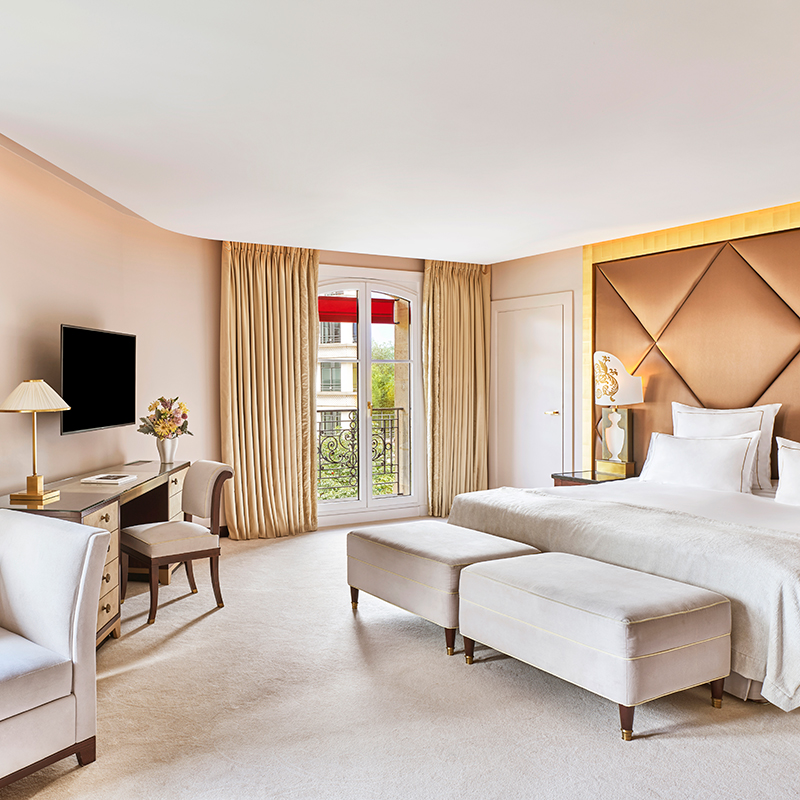
Elegant Paris hotel room with a refined interior, generous seating, comfortable bedding and a dedicated work area.
4. Parisian Room Views and Natural Light
A room with a city view can add a memorable dimension to a Paris stay. However, travelers should determine how important the view will actually be to their experience.
Guests who enjoy slow mornings, reading or relaxing inside the room may appreciate a distinctive outlook. Travelers who spend most of their days exploring may find that quietness, room size or location provides greater practical value.
Natural light also changes the character of a room. Large windows can create a feeling of openness, particularly in rooms with restrained furniture and lighter finishes.
However, natural light should be considered together with blackout curtains. A room that receives abundant morning light can be attractive during the day while being less suitable for travelers who prefer to sleep late.
Window orientation can also affect temperature and privacy. Travelers should examine photographs and descriptions carefully when a particular view or lighting condition is an important part of the decision.
5. Paris Hotel Rooms for Short City Breaks
Short Paris trips usually reward efficiency. When staying for only a few nights, the location of the hotel can be particularly important because every hour spent traveling between accommodation and attractions reduces available exploration time.
A compact but well-designed room can therefore be an excellent option for a short stay. Travelers may not need a large living area if most of the day will be spent outside.
The priorities should typically focus on comfortable bedding, a functional bathroom, good sound control, convenient storage and easy access to transportation.
Travelers can also compare the room against the intended schedule. Someone planning early morning sightseeing may place greater importance on a quiet environment and efficient breakfast arrangements, while someone planning late evenings may prioritize easy access to the hotel and strong blackout curtains.
6. Nice: Mediterranean Room Design
Nice presents a different hotel-room atmosphere. Travelers comparing a Hotel in Nice may place greater emphasis on natural light, balconies, terraces, views and climate control.
Mediterranean interiors often use lighter colors and materials to reinforce a sense of openness. Large windows can connect the room visually with the outdoors, while balconies can provide an additional area for relaxation.
Outdoor space should be evaluated realistically. A balcony is most useful when it provides enough room for comfortable seating and a reasonable degree of privacy. A very narrow exterior area may have limited practical value despite being listed as a balcony.
Travelers should also check whether the room's curtains can block strong sunlight. This is particularly important for guests who are sensitive to early morning brightness.
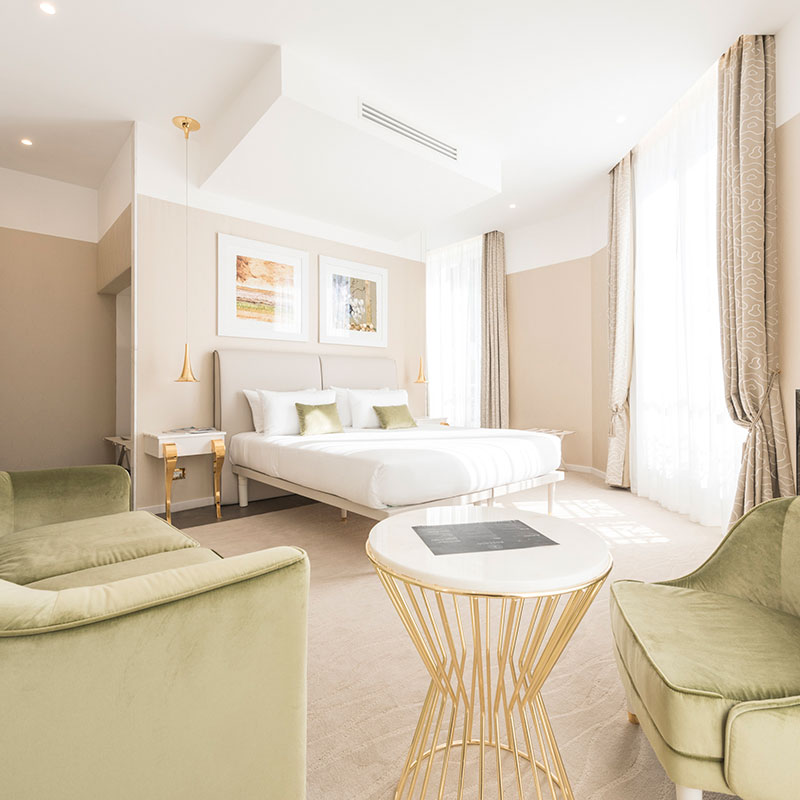
Contemporary Nice room design emphasizing natural light, practical storage, a dedicated desk and elegant furnishings.
7. Climate Control in Nice and Southern France
Temperature management deserves careful consideration in Mediterranean destinations. The visual beauty of a room cannot compensate for an uncomfortable indoor climate.
Travelers should determine whether heating and cooling are individually controlled. Individual controls generally provide more flexibility than centralized systems.
Windows also influence comfort. High-quality windows can help limit exterior noise and reduce unwanted temperature changes.
Curtains provide another layer of environmental control. They can limit direct sunlight during the hottest part of the day and create a darker sleeping environment at night.
Travelers should also consider the season of travel. Climate requirements can differ significantly between a warm summer stay and a cooler spring or autumn visit.
8. Lyon: Where Heritage Meets Modern Hospitality
Travelers exploring Hotels in Lyon can find accommodation that combines historic architecture with contemporary design.
This combination is particularly appealing for guests who enjoy rooms that feel connected to their surroundings while still providing modern conveniences.
Historic buildings can introduce distinctive ceilings, windows, flooring and proportions. Contemporary interiors can complement these features with modern bathrooms, efficient lighting, practical workspaces and updated technology.
Travelers should consider how much architectural character they want. Some guests appreciate an unmistakably historic environment, while others prefer clean contemporary lines.
Room position also matters. A centrally located hotel can simplify exploration, while a quieter property may provide better rest at the end of a busy day.
A sophisticated Lyon hotel room featuring comfortable seating, refined materials and abundant natural daylight.
9. Historic Versus Contemporary Lyon Rooms
Historic accommodation can provide a stronger sense of destination. Original architectural elements can make the room feel unique and visually memorable.
Contemporary hotels may offer advantages in room consistency, electrical infrastructure, accessibility and bathroom design.
Neither approach needs to be considered in isolation. Many French properties combine preserved architectural elements with modern furniture and technology.
This hybrid approach can be particularly effective because it creates character without sacrificing practical comfort.
When comparing Lyon room categories, travelers should identify whether the design differences are merely aesthetic or whether they also affect space, layout and amenities.
10. Marseille: Coastal Atmosphere Inside the Room
Marseille can provide an especially strong connection between accommodation and the Mediterranean landscape. Travelers comparing Hotels in Marseille may encounter rooms emphasizing sea views, natural materials, bright interiors and expansive windows.
Sea-facing rooms can change dramatically throughout the day as natural light moves across the water and surrounding buildings.
A room with large windows can feel significantly more open than one with limited daylight, but curtains and climate control remain essential.
Travelers should also examine the relationship between room position and transportation. A waterfront location may be ideal for leisure travel, while a different district may be more convenient for business appointments.
Refined Marseille suite with a calm palette, large windows, comfortable sleeping area and integrated bathing zone.
11. Understanding the Value of a Sea View
A sea view can be one of the most visually distinctive hotel features in Marseille or along the French Mediterranean coast.
However, travelers should evaluate whether the view is central to their travel experience. If the hotel is mainly used as a base for sightseeing, other features may have greater practical value.
If guests expect to spend mornings and evenings in the room, the view can become more meaningful.
Travelers should also determine whether the room provides a direct sea view, partial view or distant view. The difference can be significant when comparing room categories.
Photographs should therefore be interpreted alongside the exact room description.
12. The Bed: The Most Important Physical Element
Regardless of destination, the bed remains one of the most important features of a hotel room.
Travelers should consider mattress comfort, bed dimensions, pillow selection and the amount of space surrounding the bed.
A large bed inside a very compact room may look luxurious but leave insufficient room for luggage and movement.
Bedside tables should provide enough space for personal items. Electrical outlets should ideally be located within convenient reach.
Lighting controls beside the bed are another practical feature. Guests should not need to cross the room to turn off the main lights.
Sleep quality should also be evaluated alongside sound insulation, temperature control and blackout curtains. These environmental factors can be just as important as the mattress itself.
13. Bathroom Design as a Measure of Room Quality
A hotel bathroom should combine visual refinement with daily practicality.
Travelers should examine the shower or bathtub arrangement, available counter space, mirror lighting, ventilation and storage.
Two guests sharing a room can quickly discover the limitations of a bathroom with insufficient surfaces. A well-designed bathroom should allow personal items to remain organized without occupying every available area.
Walk-in showers can provide convenience, while bathtubs may appeal to travelers who enjoy longer stays or relaxation.
Ventilation is another important consideration because it affects humidity and overall comfort.
14. Lighting: Creating Multiple Room Atmospheres
Professional hotel lighting usually combines several sources rather than relying on one central ceiling fixture.
Bedside lamps provide localized light. Desk lamps support work. Accent lighting can emphasize architectural details, while general lighting supports practical activities.
Natural daylight provides another layer. Rooms with large windows can feel more spacious, while adjustable curtains allow guests to control brightness and privacy.
Travelers who work from their rooms should pay particular attention to desk lighting. Poorly positioned lighting can create screen glare and visual fatigue.
The best rooms give guests control over the environment rather than forcing them to use one fixed level of illumination.
15. Workspace Design for Modern Travelers
Hotel rooms increasingly serve as temporary offices. Travelers may need to answer emails, attend online meetings, review documents or organize business tasks.
A useful workspace requires more than a decorative desk. The surface should be stable and large enough for a laptop and essential equipment.
The chair should also be reasonably comfortable for extended use.
Electrical outlets should be located nearby, and reliable internet access is essential for professional tasks.
Travelers should also consider acoustic conditions. A beautiful desk is of limited value if the room is exposed to constant hallway or street noise during video meetings.
16. Storage: The Difference Between Order and Clutter
Storage becomes increasingly important as the length of a stay increases.
Travelers should look for wardrobes with sufficient hanging space, drawers for smaller items and shelves for folded clothing.
Luggage also needs a logical location. Bags that remain in the center of the room can quickly make even a spacious room feel crowded.
Business travelers carrying formal clothing should consider full-height hanging space. Families may require more shelving and drawer capacity.
A room with excellent storage allows guests to unpack and enjoy the environment without constantly navigating around luggage.
17. Seating: Creating a Room Beyond the Bed
A comfortable seating area can transform a room from a simple sleeping environment into a more versatile private space.
An armchair may be sufficient for a short stay. Larger rooms can benefit from a sofa or pair of comfortable chairs.
For couples, separate seating allows one person to read or relax while the other works or sleeps.
For business travelers, an armchair provides an alternative to working continuously at the desk.
For extended stays, seating becomes particularly important because guests naturally want to change their posture and environment throughout the day.
18. Technology That Actually Improves the Stay
Technology should simplify the hotel experience.
Reliable Wi-Fi, accessible power outlets and bedside charging are among the most useful digital-era hotel features.
Travelers can carry several devices, including smartphones, laptops, tablets, cameras and smartwatches. Convenient charging infrastructure is therefore increasingly important.
Smart room controls can also provide convenience when they are intuitive. Complicated interfaces can have the opposite effect.
The ideal approach is invisible technology: systems that work efficiently without demanding constant attention.
19. Sound Control and Sleep Quality
Noise can influence a hotel stay more strongly than many decorative features.
Potential sources include streets, elevators, corridors, neighboring rooms, restaurants, service areas and building systems.
Travelers who prioritize quietness can ask whether rooms away from elevators and major public spaces are available.
Courtyard-facing rooms can sometimes provide a different acoustic environment from street-facing rooms, although this varies by property.
Window quality, door seals and interior construction all contribute to perceived quietness.
Guests who sleep early or have early meetings should treat sound control as a major booking consideration.
20. Cleanliness and Maintenance Standards
Cleanliness is essential, but travelers should also consider maintenance.
A room can be clean while showing signs of aging furniture, worn fabrics or outdated fixtures. These details may not affect basic functionality, but they can influence the overall perception of quality.
Travelers can examine recent room photographs and look for repeated comments concerning maintenance.
Premium accommodation should ideally demonstrate consistency between marketing presentation and physical condition.
Bathrooms, carpets, curtains, furniture edges and upholstery can provide useful visual indicators when photographs are available.
21. Family Hotel Rooms: Space and Flexibility
Families need a different type of hotel-room planning.
Parents may require additional storage, larger floor space and sleeping arrangements that preserve some separation between adults and children.
Connecting rooms can be useful when available. Suites with separate sleeping and living zones can provide another solution.
Bathroom access is also important. Families may benefit from layouts that make it easy for several people to prepare without unnecessary congestion.
Travelers should verify connecting-room availability directly rather than assuming that it will be available on arrival.
22. Couples: Atmosphere and Privacy
Couples may place greater importance on atmosphere, privacy, lighting and views.
A private balcony or terrace can provide another area for relaxation, while a spacious seating zone can make the room feel more residential.
Elegant materials and carefully selected lighting can enhance the atmosphere without sacrificing practicality.
Even romantic room categories should still be assessed according to bed quality, bathroom design, storage and temperature control.
23. Boutique Hotels and Individual Character
Boutique hotels often provide stronger individual identity than large standardized properties.
Rooms may contain distinctive furniture, unusual architectural elements or locally inspired design.
This can be particularly appealing to travelers who want accommodation to become part of the destination experience.
Larger hotels may provide more standardized room categories and broader facilities. The choice should be based on the purpose of the trip rather than assumptions about which hotel format is universally superior.
When reviewing a general Hotel option, focus on the actual room you intend to reserve rather than the property-wide image.
24. Accessibility and Individual Room Requirements
Accessibility should be evaluated according to specific needs.
Potential considerations include doorway width, elevator access, step-free entry, shower configuration, bathroom space and bed height.
General statements such as “accessible hotel” may not provide enough detail for every traveler.
When a specific feature is essential, it should be confirmed directly with the property before booking.
The same principle applies to connecting rooms, special bedding arrangements and other requirements that cannot safely be assumed from general room descriptions.
25. Hotel Room Specifications at a Glance
Room Feature
What to Examine
Why It Matters
Best Use Case
Room Size
Actual square meters and usable floor area
Determines movement and storage potential
Long stays and families
Bed
Dimensions, mattress and pillows
Directly affects sleep quality
Every traveler
Bathroom
Shower, bathtub, counter and ventilation
Influences everyday convenience
All stay types
Lighting
Natural light and multiple fixtures
Controls atmosphere and functionality
Leisure and business travel
Workspace
Desk, chair, outlets and internet
Supports professional tasks
Business and remote work
Storage
Wardrobe, drawers and luggage area
Reduces clutter
Extended stays
Climate
Heating, cooling and individual controls
Supports comfort and sleep
Seasonal travel
Sound
Room position, windows and hallway exposure
Influences rest
Light sleepers
Outdoor Space
Balcony size, privacy and furniture
Adds another usable zone
Leisure stays
Technology
Wi-Fi, charging and room controls
Supports modern travel needs
Business and digital travelers
26. Transportation and Hotel Location
Hotel selection becomes more effective when transportation is considered at the same time.
Travelers planning regional journeys can examine Car rentals in France while comparing accommodation locations.
A centrally located hotel may reduce the need for a vehicle, while a property outside the city center may become more attractive when parking is easy and a rental car is part of the itinerary.
The most important question is how the hotel supports the actual journey.
Transportation costs can also change the effective value of a room. A lower nightly rate may become less attractive if the location requires expensive or time-consuming transfers every day.
27. Paris Car Rental and Hotel Parking
Travelers considering Car rentals in Paris should examine parking availability before selecting the accommodation.
A hotel may offer an excellent room but limited vehicle access. Another property may cost slightly more while offering a more practical parking solution.
The decision should depend on the itinerary. Travelers spending most of their time in central Paris may not need a vehicle, while those planning excursions outside the capital may find a car more useful.
Parking should therefore be treated as part of the accommodation calculation rather than an unrelated expense.
28. Car Rental in Nice and the Wider Riviera
Travelers using Nice as a base for regional exploration may consider Car rentals in Nice.
In this situation, hotel location, parking and road access can become significant room-selection factors.
A hotel with easy vehicle access may save time during day trips. Conversely, travelers planning to remain mostly within central Nice may prefer a property optimized for walking and public transportation.
The best decision depends on how the car will actually be used during the trip.
29. Airport Arrivals and Hotel Check-In
Arrival schedules should influence hotel planning.
Late arrivals may require confirmation of reception availability, while early arrivals may require luggage storage.
Travelers should also consider the transfer time from the airport to the hotel. A beautiful room can become less convenient if reaching it requires a complicated journey after a long international flight.
Check-out should be considered in the same way. Early departures can make airport access more important than room amenities.
30. Seasonal Hotel Room Planning
Room priorities change with the season.
Summer travelers may prioritize air conditioning, blackout curtains, ventilation and outdoor space.
Winter travelers may care more about heating, insulation, warm lighting and comfortable seating.
Spring and autumn travelers may benefit from rooms with flexible climate controls because weather conditions can change quickly.
Natural light can also become more valuable during seasons with shorter daylight hours.
31. How Hotel Design Creates a Sense of Luxury
Luxury is often created through proportion, materials and consistency rather than the sheer quantity of decorative elements.
Natural wood, stone, refined textiles and carefully selected metal accents can create a sophisticated environment.
Lighting adds another layer. Warm bedside lighting combined with brighter task lighting can make a room feel both comfortable and practical.
Furniture should have appropriate scale. Oversized pieces can dominate smaller rooms, while carefully proportioned furniture can create a feeling of spaciousness.
The strongest hotel interiors make practical features appear naturally integrated into the design.
32. Reading Hotel Photographs Like a Professional
Hotel photographs should be analyzed rather than simply admired.
Look at furniture scale, walking paths, window size, storage, bathroom access and the distance between major elements.
Examine several photographs whenever possible. One wide-angle image can create a misleading impression of space.
Check whether the photograph corresponds to the exact room category being considered.
Travelers should also distinguish between a room photographed for promotional purposes and the actual specifications attached to the reservation.
33. Reviews and Current Room Conditions
Reviews are most useful when travelers look for recurring patterns.
Repeated comments about noise, cleanliness, bed comfort, room size or maintenance can provide valuable context.
Recent reviews generally provide more relevant information than very old ones because hotels can renovate, change management or modify facilities.
However, individual preferences vary. A traveler who considers a 25-square-meter room small may have different expectations from someone who spends most of the day outside.
Reviews should therefore be interpreted in relation to personal requirements.
34. Longer Stays and the Need for More Space
Long stays amplify the importance of small design decisions.
Storage becomes more valuable, seating becomes more useful and workspace can become essential.
Travelers who stay for a week or longer should consider whether the room can support multiple daily activities without feeling crowded.
A separate seating area can create useful separation between work and relaxation.
A larger bathroom can also reduce daily friction when multiple people share the room.
35. Measuring Hotel Value Beyond the Price Tag
The cheapest room is not always the most economical choice.
Travelers should calculate the complete cost of accommodation, including transportation, parking, breakfast and potential room upgrades.
A hotel that costs slightly more but reduces daily transportation can provide better overall value.
A larger room can also be worthwhile for longer stays because its additional space is used repeatedly throughout the trip.
When comparing Hotels & Resorts in France, value should therefore be measured according to actual usage rather than nightly price alone.
36. Building a Personal Room Priority List
Before comparing properties, travelers should divide features into three groups: essential, desirable and optional.
Essential features might include a particular bed configuration, accessible bathroom, quiet environment or climate control.
Desirable features could include a balcony, view, larger seating area or premium bathroom.
Optional features might include additional technology or decorative upgrades that would be pleasant but are not necessary.
This method prevents attractive photographs from distracting travelers from their actual requirements.
37. Choosing the Right Room for a Business Trip
Business travelers often need efficiency above all else.
A practical desk, reliable internet, comfortable chair, accessible power and quiet environment can be more useful than decorative features.
Location also matters because daily commuting can consume valuable time.
Blackout curtains and comfortable bedding can support early schedules and recovery after long workdays.
The ideal business room is a place where guests can work efficiently and rest without unnecessary friction.
38. Choosing the Right Room for a Leisure Trip
Leisure travelers may have greater flexibility to prioritize atmosphere.
A balcony, beautiful view, lounge chair or distinctive architectural interior can add enjoyment to the stay.
However, the room should still provide strong fundamentals such as comfortable bedding, functional bathroom facilities and effective climate control.
The correct balance depends on how much time will be spent at the property.
39. Multi-City French Itineraries
A multi-city journey can benefit from choosing different room priorities at each destination.
Paris can emphasize location and architecture. Lyon can emphasize heritage and modern functionality. Nice can prioritize natural light and outdoor space. Marseille can highlight coastal atmosphere and transportation flexibility.
Travelers should not assume that the same room characteristics are equally valuable everywhere.
At the same time, a consistent baseline should remain: comfortable bedding, good cleanliness, practical bathroom design, suitable climate control and adequate quietness.
40. Special Occasion Accommodation
Special occasions naturally increase the importance of atmosphere.
A suite with a memorable view, elegant interior or private terrace can become part of the celebration itself.
Couples may appreciate larger bathrooms, comfortable seating and layered lighting.
However, special-occasion rooms should still be assessed according to practical comfort. Beautiful decoration does not replace a comfortable bed or well-designed bathroom.
41. Modern Luxury Without Unnecessary Excess
Modern luxury increasingly focuses on quality rather than quantity.
A calm room with excellent materials, comfortable furniture and thoughtful lighting can feel more luxurious than an interior crowded with decorative features.
Convenience itself can be luxurious. Easy charging, sufficient storage, adjustable temperature and effective sound insulation can improve the stay every day.
The strongest premium rooms make comfort feel effortless.
42. Sustainability and Responsible Hotel Design
Travelers increasingly consider how hotels use energy, water and materials.
Room-level climate controls can reduce unnecessary heating or cooling. Efficient lighting can lower energy use, while durable materials can reduce the need for frequent replacement.
Thoughtful design can therefore combine comfort with responsible resource management.
Travelers interested in sustainable accommodation can examine hotel policies and facility information before booking.
43. The Role of Furniture Proportion
Furniture scale can dramatically affect the perceived size of a room.
Large furniture may work beautifully in a suite but overwhelm a compact urban room.
Smaller, carefully proportioned pieces can preserve walking space and create a more open visual impression.
When reviewing photographs, travelers should look at floor area rather than simply counting furniture pieces.
44. Designing the Room Around Your Daily Routine
The ideal room supports the way you actually behave during travel.
Early risers may appreciate natural light. Late sleepers may prefer strong blackout curtains.
Remote workers need desks and outlets. Leisure travelers may prefer balconies or comfortable lounge seating.
Guests who return late after sightseeing may care most about a quiet environment and a comfortable bed.
Thinking about the daily routine is one of the simplest ways to improve hotel selection.
45. Why Location and Room Quality Must Be Considered Together
A beautiful room cannot compensate for a location that creates unnecessary travel every day.
Conversely, a highly convenient location may not provide enough comfort if the room is noisy, cramped or poorly maintained.
The best accommodation decision balances both factors.
Travelers should therefore create separate criteria for location and room quality before combining them in the final comparison.
46. The Importance of Storage During Family Trips
Family travel can create significant storage requirements.
Children's clothing, shoes, accessories and personal items can quickly occupy the room.
A larger wardrobe and additional drawers can therefore have a greater impact than decorative upgrades.
Families should also consider whether luggage can be stored without blocking pathways.
47. Hotel Rooms for Digital Nomads and Remote Professionals
Remote professionals need accommodation that supports productivity without sacrificing rest.
A strong workspace, stable internet, sufficient charging and comfortable seating are essential.
Acoustic privacy is also valuable for online meetings.
A room with a separate lounge area can allow work and relaxation to occupy different zones, creating a more balanced experience.
48. Hotel Room Planning for Extended French Holidays
Travelers spending several weeks in France should consider accommodation almost as temporary residential space.
Kitchenette access, laundry facilities, storage, seating and workspace can become more valuable than decorative upgrades.
Location also becomes increasingly important because daily transportation costs accumulate over time.
Travelers should calculate the complete accommodation and transportation budget rather than focusing exclusively on the room's nightly price.
49. The Professional Hotel Comparison Method
A reliable hotel comparison can be completed through five stages.
First, define the destination and neighborhood. Second, determine the purpose of the trip. Third, identify essential room specifications. Fourth, compare exact room categories and total costs. Fifth, verify any essential requirements directly with the property.
This process reduces decision fatigue and makes it easier to distinguish genuine value from attractive marketing presentation.
Travelers can also revisit Hotels in Lyon when comparing French city stays according to room layout, location, design and transportation access.
50. A Detailed Hotel Room Evaluation Table
Evaluation Area
Questions to Ask
Priority for Short Stay
Priority for Extended Stay
Location
Does it reduce daily travel time?
Very High
High
Bed
Is the sleeping configuration suitable?
Very High
Very High
Bathroom
Does it provide sufficient space and functionality?
High
Very High
Room Size
Is there enough usable space?
Medium
Very High
Storage
Can luggage and clothing be organized?
Medium
Very High
Workspace
Can work or trip planning be completed comfortably?
Medium
High
Quietness
Will the room support uninterrupted rest?
Very High
Very High
Outdoor Space
Will the balcony or terrace actually be used?
Medium
High
Climate Control
Can the temperature be adjusted?
High
Very High
Technology
Are internet and charging facilities adequate?
High
Very High
51. Frequently Asked Questions About French Hotel Rooms
What is the most important feature of a hotel room?
There is no single feature that works for every traveler. Bed quality, room layout, location, bathroom design, sound control and climate management are generally among the most important practical considerations.
How should I choose a hotel room in Paris?
Compare the exact room category, location, room dimensions, bed, bathroom, storage, noise exposure and transportation convenience. Parisian architectural character can be an important additional factor for travelers who value design.
What makes Nice hotel rooms different?
Nice accommodation often places greater emphasis on natural light, balconies, terraces, outdoor views and climate control. Travelers should evaluate these features according to the season and planned itinerary.
Should I choose a historic hotel in Lyon?
A historic property can provide distinctive architecture and a stronger sense of place. Travelers should also check room dimensions, bathroom configuration, elevators and modern facilities before booking.
Are Marseille sea-view rooms worth the additional cost?
The answer depends on how much time you expect to spend in the room. A sea view can be valuable for travelers who enjoy the accommodation itself, while active itineraries may place greater value on location, quietness or room size.
What should families look for in French hotel rooms?
Families should consider room size, storage, connecting rooms, bathroom access, sleeping arrangements and safe circulation space. These practical factors can be more useful than decorative upgrades.
What matters most for business travelers?
Reliable internet, a comfortable workspace, charging access, quietness, good lighting and convenient transportation are usually important considerations.
How can I get better value from a hotel room?
Compare the complete cost of the stay, including transportation, parking and useful amenities. Choose upgrades based on features you will actually use rather than simply selecting the most expensive room.
52. The Ultimate French Hotel Room Checklist
Confirm the exact room category before booking.
Check the room's stated square meter area.
Verify the bed dimensions and configuration.
Review bathroom type and shower or bathtub arrangement.
Check the available bathroom counter and storage space.
Look for wardrobe, drawer and luggage-storage capacity.
Review natural light and window orientation.
Confirm blackout curtain availability when important for sleep.
Check air conditioning and heating controls.
Consider the room's position relative to elevators and corridors.
Evaluate workspace quality when working remotely.
Check internet and charging facilities.
Determine whether a balcony or terrace is genuinely usable.
Compare exact room photographs rather than general hotel photographs.
Review recent information about room condition.
Consider transportation and parking before finalizing the hotel.
Match room features with the season of travel.
Compare total stay cost rather than only nightly price.
Confirm essential accessibility requirements directly with the property.
Choose the room according to your actual daily travel routine.
53. Planning a Complete French Accommodation Experience
A carefully selected hotel room can become one of the most valuable elements of a French journey. It provides a place to sleep, recover, work, organize belongings and experience a small part of the destination through architecture and design.
In Paris, the ideal room may balance historic character with practical comfort. In Nice, natural light and outdoor space can become central to the experience. Lyon can appeal to travelers who enjoy the combination of heritage architecture and contemporary interiors. Marseille can create a stronger connection between the hotel room and the Mediterranean landscape.
Travelers considering Hotels in Marseille should therefore examine the complete room experience rather than relying on a single visual feature.
The same principle applies throughout France. The strongest accommodation decision is created by combining location, room design, comfort, practical facilities and transportation into one coherent travel plan.
For travelers looking to refine their planning process, the most useful approach is simple: define what the room needs to accomplish, identify the features that make that possible, compare the exact room categories and evaluate the total experience rather than the promotional image alone.



Comments
Post a Comment